Showing posts with label Grammar. Show all posts
Showing posts with label Grammar. Show all posts
Wednesday, November 8, 2017
Grammar: Quantifiers!
There are a lot of quantifiers out there. A lot of, many, much, lots of... but how do we use them all? If you want good answers to tough questions about English grammar who do you look to? THE ENGLISH of course! Check out this link from Cambridge English to learn more about how, when, and where to use quantifiers properly and effectively.

Thursday, March 10, 2016
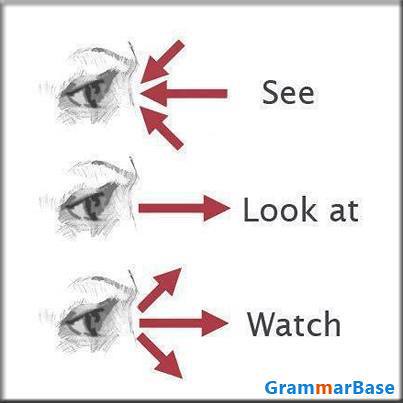
Look vs See vs Watch
I've had a lot of students ask me about the difference between these words over my time here and the answer is not always easy to give. However, if you go to this link you will see an easy to understand explanation.
Go here to try an exercise.
Go here to try an exercise.
Thursday, February 4, 2016
B2.1 So and Such
Hello everyone! Here is an activity to practice So and Such usage. There are many situations where we can use either one of these verbs so its good to practice using them a lot.
Explanation
Exercise
Video Explanation!
Explanation
Exercise
Video Explanation!
A2 Using suggest correctly.
Hey A2.3! Here's a good video on how to use the verb suggest in many different ways. I SUGGEST you take some notes and I SUGGEST you pay close attention! :D
Thursday, January 28, 2016
Mixed Conditionals
Here I have compiled a list of websites that contain explanations and exercises related to the 3rd and Mixed Conditionals.
This website, has a great explanation of Mixed Conditionals as well as an exercise for you to practice. The explanation. The exercise.
Another website with further explanation and exercises.
British Council: Conditionals.

This website, has a great explanation of Mixed Conditionals as well as an exercise for you to practice. The explanation. The exercise.
Another website with further explanation and exercises.
British Council: Conditionals.
Question Tags
Please remember the format for question tags!
Positive statement verb = Negative question tag verb.
ex. Andrew posted something new on his blog, didn't he?
Negative statement verb = positive question tag verb.
ex. I'm not lazy, am I?
Go HERE to practice question tags. And check this infograph for more about question tags.

Intonation- the way we say a word or phrase.
Positive statement verb = Negative question tag verb.
ex. Andrew posted something new on his blog, didn't he?
Negative statement verb = positive question tag verb.
ex. I'm not lazy, am I?
Go HERE to practice question tags. And check this infograph for more about question tags.
Intonation- the way we say a word or phrase.
Thursday, January 21, 2016
B2 and up News Reports
Hi there!
If you are in one of my B2 or higher General English classes you will be expected to regularly complete a story of the week report. The purpose of these reports is to become exposed to news stories and other media that is regularly consumed by native speakers. This activity will help in the areas of listening, reading, vocabulary, and grammar. Please use the links on the back of the page I provide to you or feel free to use any of the links placed here.
News:
VICE news
British Broadcasting Corporation (BBC)
Reddit World News - once you arrive at the website, click any link to get to another news story. Reddit is also a great website to explore in your free time.
Stories:
This American Life
This American Life is a weekly public radio show broadcast on more than 500 stations to about 2.2 million listeners. It is produced in collaboration with Chicago Public Media, delivered to stations by PRX The Public Radio Exchange, and has won all of the major broadcasting awards. It is also often the most popular podcast in the country, with another 2 million people downloading each episode.
Radiolab from WNYC
Radiolab is a show about curiosity. Where sound illuminates ideas, and the boundaries blur between science, philosophy, and human experience.
American History and Comedy:
The Dollop
The Dollop is a weekly podcast written and produced by American comedians Dave Anthony and Gareth Reynolds. Every week they discuss a topic related to US or American history. Podcasts are usually one hour and contain some foul language.
Phrasal Verbs:
The last area of the paper I want you to complete is the phrasal verb section. Please see this link to get a review of phrasal verbs.
If you are in one of my B2 or higher General English classes you will be expected to regularly complete a story of the week report. The purpose of these reports is to become exposed to news stories and other media that is regularly consumed by native speakers. This activity will help in the areas of listening, reading, vocabulary, and grammar. Please use the links on the back of the page I provide to you or feel free to use any of the links placed here.
News:
VICE news
British Broadcasting Corporation (BBC)
Reddit World News - once you arrive at the website, click any link to get to another news story. Reddit is also a great website to explore in your free time.
Stories:
This American Life
This American Life is a weekly public radio show broadcast on more than 500 stations to about 2.2 million listeners. It is produced in collaboration with Chicago Public Media, delivered to stations by PRX The Public Radio Exchange, and has won all of the major broadcasting awards. It is also often the most popular podcast in the country, with another 2 million people downloading each episode.
Radiolab from WNYC
Radiolab is a show about curiosity. Where sound illuminates ideas, and the boundaries blur between science, philosophy, and human experience.
American History and Comedy:
The Dollop
The Dollop is a weekly podcast written and produced by American comedians Dave Anthony and Gareth Reynolds. Every week they discuss a topic related to US or American history. Podcasts are usually one hour and contain some foul language.
Phrasal Verbs:
The last area of the paper I want you to complete is the phrasal verb section. Please see this link to get a review of phrasal verbs.
Thursday, January 14, 2016
Modal Verbs A2.2, A2.3, B1.1
A modal verb (also 'modal', 'modal auxiliary verb', 'modal auxiliary') is a type of verb that is used to indicate modality – that is, likelihood (chance), ability, permission, advice and obligation. Examples include the English verbs: can/could, may/might, must, will/would, and shall/should.
This website really shows the best way to use all of these modal verbs. Modal verbs are quite strange in English so the best way to learn about using them is practicing. Practice writing and speaking with them to best understand.
Also, this guy is not very exciting, but his explanation is simple and PERFECT!

This website really shows the best way to use all of these modal verbs. Modal verbs are quite strange in English so the best way to learn about using them is practicing. Practice writing and speaking with them to best understand.
Also, this guy is not very exciting, but his explanation is simple and PERFECT!
A2.3 Relative Clauses beyond the classroom.
What is a relative clause?
A relative clause is one kind of dependent clause. It has a subject and verb, but can't stand alone as a sentence. It is sometimes called an “adjective clause” because it functions like an adjective—it gives more information about a noun. <---- The most important thing!
Please go to this link to find a PDF file with many relative clause exercises.
A relative clause is one kind of dependent clause. It has a subject and verb, but can't stand alone as a sentence. It is sometimes called an “adjective clause” because it functions like an adjective—it gives more information about a noun. <---- The most important thing!
Please go to this link to find a PDF file with many relative clause exercises.
Wednesday, January 13, 2016

Subscribe to:
Posts (Atom)